
4 Types of Lawn Fungus in Northwest Indiana (And How to Tell Them Apart)
If your lawn has fungus this year, you’re not imagining that it’s worse than usual. Northwest Indiana just had one of the wettest summers on record - and that’s created a perfect storm of exactly the conditions fungal disease needs to spread. Here’s why it’s happening, and the four types showing up most on lawns across the region right now.
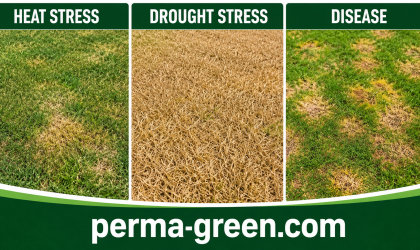
If you’re still not sure it’s disease at all, start here to rule out heat or drought stress first.
For the full picture of why this humidity is driving disease region-wide, see Perma-Green’s Northwest Indiana’s Extreme Humidity Causes Grass Disease.
What Causes Lawn Fungus to Spread
Fungus spreads where moisture sits on the grass blade for extended periods. Humid air, heavy or frequent rainfall, poor air circulation around dense turf, and evening watering that leaves grass wet overnight all create the same result: a longer window for fungal spores to germinate and spread. Lawns that are already stressed from compaction or nutrient deficiency are even more vulnerable, since weakened turf has less natural resistance.
The 4 Common Types of Lawn Fungus in Northwest Indiana
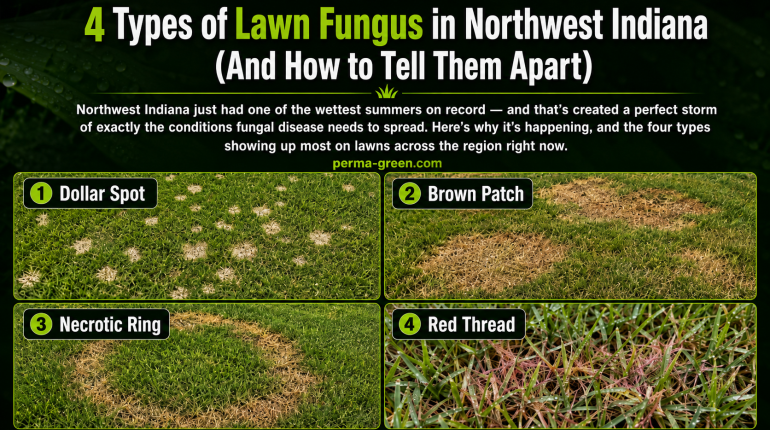
There are four fungal diseases we’re seeing most often across Northwest Indiana lawns this season, and while they share some root causes, they don’t look alike and they don’t respond to the same treatment. Brown patch shows up as circular or irregular brown patches with a darker “smoke ring” edge. Dollar spot appears as small, silver-dollar-sized bleached patches, often linked to low nitrogen. Red thread is the most visually distinct - pink or reddish thread-like growth on the blade tips. Necrotic ring spot forms expanding dead rings that are easy to confuse with brown patch but behave differently over time.
Prefer to listen? This episode covers the same four fungus types in podcast form: ENCORE: Lawn Fungus! What is Turfgrass Disease & What Can You Do!.
Why Your Location Changes the Risk
Where you are matters here too. A Valparaiso lawn on clay soil holds moisture long enough to be a strong candidate for brown patch or dollar spot, while a DeMotte lawn on sandy soil is more likely to dry out between storms - meaning the same wet summer produces a different dominant risk depending on your soil.
See your area’s soil type, rainfall data, and local Daly’s Tips: Chesterton · Crown Point · DeMotte · Hobart · Valparaiso · Lake County · LaPorte County · Porter County
For the soil science behind this, Purdue’s Turfgrass Science program is a good authoritative resource. Also see Lawn Disease Alert: A County-by-County Northwest Indiana Guide for the full county risk breakdown.
Find Your Specific Diagnosis
Each of the four diseases above gets its own closer look, including exactly what to check for and what treatment approach fits. If you’re already fairly sure which one you’re dealing with, jump straight to it. If not, start with brown patch, since it’s the one we’re seeing most this season. Not sure at all? A Perma-Green lawn evaluation can confirm exactly what you’re dealing with on-site. See the full range of services this can lead to: Lawn Care Services.

What Comes Next: Fall Lawn Recovery
If fungus, heat stress, drought stress, heavy rain, or thinning turf weakened your lawn this summer, fall is the recovery window.
Fall fertilizer helps the lawn rebuild strength, support root growth, store nutrients before winter, and prepare for healthier growth when the ground thaws in spring.
READ:
Northwest Indiana Lawn Recovery Starts This Fall
Why Fall Fertilizer Is the MVP Treatment for Northwest Indiana Lawns
Not sure what is affecting your lawn?
Get a free Perma-Green lawn evaluation before guessing at the fix.